Monday, June 21, 2010

Experiences with Commuter Rail


I've been making the case lately that rail transit systems are very much a net loss for cities (except those with a high population density, like New York). Increasingly, I think trains are more expensive/less efficient than other forms of transportation, less flexible (locking cities into long-term decisions that they may soon regret), and in sum make a city less productive and as a result marginally poorer.

While admiting that they are a less efficient form of transporation than buses, supporters have argued that streetcars cause development to occur along the line. Others, including myself, have pointed out that this is just reshuffled development (It's like offering P&G a tax incentive to move from 5th to 13th Street and then asserting the tax incentive created a $175 Billion company). As this development is created inefficiently and very expensively, the project is a net loss to the city (especially considering the other more efficient uses for those funds).

Unfortunately, lacking from Cincy Streetcar discussions is evidence of how rail transit has actually performed in comparable cities. This post is my limited attempt to measure performance.

To create a group of peer cities to compare to Cincinnati, I took Wikipedia's list of the ten largest cities in the Midwest and then added any cities within 250 miles of Cincinnati with a population greater than 300,000 that weren't already included (Pittsburgh and Nashville). I compared changes in population since 1990. Population, in addition to being easily available, is a good proxy for economic performance and the overall job market. The change since 1990 is a good measure of a city's long-term growth and fortunately there are several comparable cities who have had train systems for this full period. I put this information into a table, along with some notes on the transportation systems of each city.

My theory going in is that rail transit is a much more expensive way to transport people than buses. Since it is relatively inefficient (except in dense metro areas), rails should be a long-term drag on the economic performance of a city. So, empirically you would expect cities with rail transit to perform worse than those with buses in the long-term. Here's what I found:
Here are the totals for all cities with and without rail:

These results were more or less what you would expect, although the trend is stronger than I anticipated. Chicago, an outlier in the Midwest with much higher density, does alright with rail. The other cities who have built passenger rail systems have all performed very poorly in the long run. On the other hand, those cities who have relied on bus transportation over the last 30 years have on average grown by 10%. Unfortunately Cincinnati has been the worst performer of the bus group, but is still doing better than every city with rail transit except Chicago.

I can anticipate a couple critiques of this data: First, these cities all have their own issues and transportation systems are not responsible for all variances (Detroit would still have issues with any system). It may be the case that cities that are likely to build rail systems are also likely to be poorly governed or just in relative decline already - So, correlation, not necessarily causation. I think there is some truth to this point, however transportation is still relevant (otherwise, why are we spending on it?) Another objection could be that the Cincinnati Streetcar Plan is different from those discussed here. There's some truth to this also, but this data seems to show that the more similar the transportation system to the one proposed in Cincinnati, the worse the city's performance.

Thus, my conclusion from looking at this information is that it is further good evidence that rail transportation is not a valuable investment for a city like Cincinnati. There are very strong relationships in the region between rail transit and stagnation. This is consistent with my view that rail transit (except in high density cities) is an inefficient waste that turns out to be a drag on a city's long-term performance. So, I confirmed my opinion going in... Finally, I would just encourage more tracking of actual performance of projects of this type (For example, a lot more could be done to measure performance outside of the Midwest). I have seen a disappointing lack of evidence that rail transit has or can perform well in a city like Cincinnati, only assertions that it will do exceptional things (countered by convincing evidence that it is inefficient waste). I'm open to such evidence, but suspect the lack of it is a sign that it doesn't exist.

Tuesday, June 15, 2010

Why Do People Like Streetcars?

I have become increasingly convinced that the streetcar project is a major misstep for the city. However, there is significant support for the streetcar plan among those who are knowledgeable about local issues in Cincinnati.

Streetcars were a smart form of transportation (and actually profitable for companies to run) in the old days when the internal combustion engine had a very low efficiency. I suspect this nostalgia for the old days is one of the reasons they receive some popular support. But now streetcars have all of the problems of buses with none of the advantages (Some argue that it’s an advantage that the system is inflexible and people know the routes cannot quickly change. However, if you think this is important why not try to propose an amendment to the city’s constitution that locks in bus routes? I’d say because that’s not a very good idea. All else equal, it’s better to have a flexible system that can adjust to changes in development and transportation needs).

The city’s current plan is to spend $30 million per mile constructing a streetcar system that will lose about 60% ongoing (and thus never pay back any of the capital). Throw in the significant budget deficit the city already faces and I think the financial argument against streetcar spending is overwhelming. Yet, if the city insists on spending the money - We live in a world of tradeoffs, so they must consider the alternatives uses of those funds. I can think of many, but the obvious alternative is another transportation option: Buses. With the capital costs, streetcars are much more expensive than additional bus service.

As streetcars are an inferior technology, the persistence of public support is a small puzzle. As far as I can tell, there are a few reasons people prefer streetcars to buses. The first is nostalgia. There seems to be a view that a streetcar will make Cincy more popular with tourists. But, I don’t see this being much of a factor as every other city seems to be sinking money on streetcars. They simply don't differentiate the city and aren't a tourist attraction like SF cable cars.

Another further reason for support is offered up by Megan McArdle at the Atlantic:
The streetcars I'm most familiar with are Philadelphia's… so let me offer my take on why people (read: affluent, especially white people) like streetcars: they don't have so many poor people on them.

Streetcars are developed in a fixed area and not frequently expanded. They have a high capital cost. This means the area along the lines gentrifies. Thus, when you get on a streetcar, it normally has a lot of other affluent people on it. By contrast, when you get on a bus, it normally has a lot of poor people who have been sitting on it for an hour, patiently waiting to get to work. The association builds between streetcars and affluence, busses and poverty, in one's mind.
Even though streetcars may help gentrify a neighborhood, that doesn’t mean they’re a good investment. Sinking a bunch of the city’s money into a loser investment may be good for the effected neighborhood, but is still a net loss for the city.

Economic growth is fundamentally about productivity improvement. Streetcars are a move in the opposite direction and make the city a little poorer. The streetcar project is not as bad as say spending funds on a monorail, but it’s still a waste. Streetcars wouldn’t make Cincinnati the next San Francisco or Portland. They’d make Cincinnati more like St. Louis and Cleveland - poorer versions of Cincinnati with light rail.

Sunday, May 23, 2010

New Cincinnati Streetcar Poll

There's a new poll out by SurveyUSA on support for the Streetcar within the city of Cincinnati. The Key findings are:

48% Cincinnati residents believe the streetcar is a "waste of taxpayer money".
7% are unsure
20% say it's a risky project
and just 27% say is will "Revitalize Cincinnati's core"

51% say most of the ongoing funding for the streetcar should come from fares. In reality, even supporters' ridership assumption will pay for much less than half. If all voters were aware of this, I suspect support would fall further.

When it comes to actually paying for the project: 61% disapprove of the city borrowing of $64 million to pay for the Streetcar, and only 31% approve.

So, there is overwhelming opposition within the city to the streetcar plan just passed. It seems the majority correctly see the project as an unnecessary burden and hindrance to future growth in the city. This poll should be devastating to the Streetcar project. So, why is it being pushed through, if not in response to the wishes of voters? Once again, I suspect it might have something to do with support for the streetcar among certain special interests (landowners and businesses along the route) who see a large profit opportunity.

I believe this issue should not be decided by elected officials, who are more easily influenced by the small group who will benefit from the project (like pork legislation). This is essentially a special interest project and given it's size should be put to an up/down vote on the ballot. The city and the taxpayers should be allowed to decide this one. Tom Luken has said he will circulate petitions to place the streetcar on the November ballot. That would be very good for the city of Cincinnati.

Thursday, May 13, 2010

Cost & Benefit Analysis of the CincyStreetcar

Through the streetcar debates quite a few numbers have been cited on the economic benefits of the Streetcar project in Cincinnati. I believe they deserve more scrutiny. The study that has been used to provide the economic backing for the streetcar is the Cincinnati Streetcar Economic Analysis from 2007, which is posted on Cincinnati-oh.gov.  The report was produced by HDR Decision Economics, a Maryland-based for-profit architectural, engineering and consulting firm. Their numbers produce a 2.7 to 1 Economic Benefit to Cost ratio. The following is some detail and analysis of the HDR study:

Assumptions:
First, let's examine some of the assumptions. The study assumes that the population of the city will continue to declines as will commercial real-estate units in the central business district. To give you an idea, here's the city population graph cited:
The study's "Community Development Benefits" are based off this base-line. However, the baseline doesn't appear to be accurate. Census restatements have shown the city has actually grown since 2000, and the populations of downtown and OTR have increased at a swift pace. The principle benefit of the project is difference between the "projected incremental growth in property values in the Base Case (without a Streetcar System) and Alternative (with a Streetcar System) over the period 2008- 2042." This benefit takes into account the opportunity of unused real-estate along the route that has a large potential upside. But, since growth has already occurred without the streetcar, this potential upside is overstated. Also, they don’t take into account the casino (Of course, how could they in 2007), which is also working to increase occupancy in downtown and OTR. As you can’t really redevelop the same unused building twice, the study is likely overstating this potential benefit.

Here are the projected Usable Residential and Commerical Real Estate Unit Growth in Over the Rhine with (blue) and without (pink) the Streetcar. They project a decline in usable real-estate in OTR without the streetcar. This has not been the case in the three years since the study took place, and it certainly doesn't gut check with me - especially with the various new developments going on in the area.
Actual Growth / Political Economy:
So, I believe the study has an overly negative base-line forecast for Over-the-Rhine. However, this does not disprove that there will be some additional growth due to the streetcar. The study’s authors point to increases in property values along streetcar lines in other cities (It’s worth mentioning that most of the cities are studied during the recent property bubble, so they almost certainly have overstated property value gains). Nonetheless, I believe this claim. This comment about Philadelphia is typical “Voith (1993) found a premium for single family homes with access to rail stations of 7.5% to 8.0% over the average home values.” That is fair enough - When expensive transportation is provided along a certain route, the value of land along that route is higher than other land not served by the mass-transit. The city has decided to spend a disproportionate amount of it's transportation budget along a certain route, and of course the land values will increase somewhat along the well-served route. If not, there would be no benefit at all to public transportation, which I don't believe is true. The relevant question is whether the benefits exceed the costs.

The study estimates the total Residential property along the route will see a value increase of $107 million and the Commercial real estate will increase by $272 million (in NPV). Due to the inaccurate assumptions above, this almost certainly overestimates the benefit of streetcars to the affected neighborhoods. Nonetheless, I’m sure there will be some value that landowners will be able to collect from being relatively advantaged transportation-wise. And, if there are few landholders who think they can gain a significant chunk of this $379 million benefit, they will be willing to exert a lot of influence to make sure this project goes through. This presents a political-economical problem.

Cost Benefit to the City Budget:
HDR uses a Monte Carlo simulation (a common statistical technique) to produce a median expected annual operating cost of $2.2 million for the streetcars. The Economic analysis does not include fare estimates. However, an Feasibility Study included on the city's website estimates ridership of 4,600 per day with a $0.50 fare. This implies 4,600 x $0.50 x 365 = $840,000 in revenue annually. So, even in the study sponsored by the city, fares will only be able to cover 38% of operating costs. Compare this to the much more economically rational New York subway, where fares cover 67% of operating expenses.

Furthermore, if you include the capital costs (As basic finance says you should) and assume a 30 year depreciation - That’s $75.7 million (the study’s capital assumption, not the $128 million now proposed) / 30 years = $2.5 million annually.

Thus, annually: $840,000 Revenue - ($2,200,000 operating cost + $2,530,000 Depreciation) = $3,890,000 in projected annual losses for each of the next 30 years.

So, by the project’s own estimates fares will pay for 18% of the streetcar - much less than the current rate for Metro buses. Also, worth mention - This budget structure is much less flexible than Metro, as over half of its funds are tied up in debt payments. If, as happened recently, a budget cut is mandated - we may have to cut 10% of bus service. But an equal percentage budget cut to a streetcar system may require a 20% cut in service, as its debt payments to cover the large capital expense cannot be cut.

Cost Benefit to Cincinnati:
So, the streetcar will put Cincinnati's goverment further into debt. This strikes one as unwise after the upheaval over last year's budget cuts. Nonetheless, the streetcar could conceivably be worthwhile if the benefits to the community are large enough. Here is how HDR lists the total Costs and Benefits of the project:
The study lists Travel Cost Saving Benefits and Mobility-related Benefits, both of which are debatable. But as they are relatively small, I will taken them as given. However, 88% of the projected benefit comes from the aforementioned $379 million in Community Development Benefits. This is the expected increase in property values due to the streetcar. HRD assumes the streetcar will stimulate economic development that would not have otherwise occurred. Yet, they only forecast property values along the route. It is implicitly assumed that there is no effect on the rest of the city and the streetcar does not displace other growth. This is the key assumption in the study, which makes their analysis positive.

On this, I would fault the study for being insufficiently reflective. HDR only tells us that property values will probably go up along the route (obviously). It does not estimate the net effect for the city, and so quietly assumes that there cannot be a downside. So, it does not take into account all the factors you would want to consider when making an investment decision. The Cato Institute (admittedly a libertarian think tank) makes this argument about streetcars displacing invesment “To the extent that rail transit increases property values along its route, for an urban region as a whole, this is a zero-sum game: increases along the route are offset by lower property values elsewhere. It may even be a negative-sum game is higher taxes and land-use regulation need to support the rail lines discourage economic growth.” The City's Streetcar page includes a limited response to Cato's study, but it does not address this very important point.

Let me give an exaggerated example. The city could give a large tax incentive to move offices to 13th Street. However, if Procter and Gamble agrees to move it does not mean that tax break was a brilliant move with a great payback. It does not mean that the policy produced the benefit to the city of now having P&G's offices at a relatively small expense. It would significantly increase land values on 13th Street, but this would not be a net gain for the city. This is merely reshuffling development. But, this type of activity has been included in the growth assumptions based on the experiences of other cities. The Federal Transit Administration has found that “urban rail transit investments rarely ‘create’ new growth,” they “redistribute growth that would have taken place without the investment.” This benefits those who own property along the route, but does not benefit the city.

With the streetcar, marginally more restaurants and apartments will most likely pop up along the route. However, just about all of this development would have occurred elsewhere in the city - People do have to eat and sleep. More development will occur along the route because that will probably be best (and most expensively) served area in the city transportation-wise. Other areas will be marginally more poorly served, both because they have to pay for this benefit for this politically favored route with their taxes and because their own budgets will be squeezed to help pay for the streetcar.

My Conclusion:
Here are my major points:
- The Benefits that will accrue along the proposed streetcar route are exaggerated, but do exist.
- The Streetcar will put the city further in debt, and will never operate near a profit.
- The Benefits to property values along the route will be offset by a decline in property values elsewhere in the city.
- As a result, taking into account the streetcar's price tag, a streetcar investment would be a bad deal for Cincinnati.

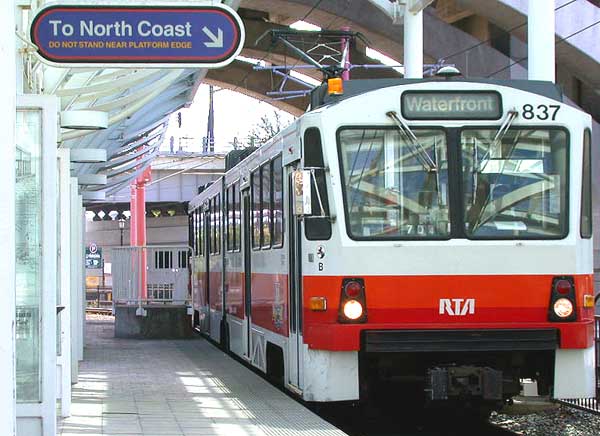
As for my recommendation - There have been many cities that have seen a strong increase in mass transit ridership in recent years. That increase is attributable to buses. They are simply a better economic decision. ...Instead of New York or Portland, I think a more relevant comparison for Cincinnati mass transit is to Cleveland's RTA Rapid Transit. There are some differences and the Cleveland mass transit system is larger and a little different than the one proposed in Cincinnati. But Cleveland is one of the most similar cities to Cincinnati and is under the same state government. Cleveland has a significant rail mass transit system with 30,000 daily riders, Cincinnati does not. Which city is more prosperous and dynamic? The difference isn't all due to the streetcar, but this is an example we should look at when planning our transportation future.

If Cincinnati sinks money into at a streetcar system, in ten years it will find itself with a larger fiscal problem, a marginally worse transportation system, and relatively less competitive.

Tuesday, May 11, 2010

Why Streetcars?

I wanted to write something about the streetcar. Unfortunately, it's impossible to find the campaign contributions to the council members who voted for the streetcar online...

It is often claimed by streetcar supporters that the project will pay for itself with increased tax revenue. Chris Bortz (C - Towne) has claimed the project would have a 14 to 1 return. He may also believe that if Cincinnati replaced all roads with rails, it would become by far the richest city on the Earth.

I don't doubt that a streetcar will drive some investment along the route (as other cities have experienced). This is why the landowners who support the streetcar do so. However, I think this development will mostly just be displaced investment that would have happened somewhere else locally, and the it will happen at the expense of other neighborhoods in the city that will have to pay for the system. So, why should Price Hill have to pay to enrich landowners in OTR? It doesn't seem fair to me, especially if it's a bad deal for the city overall.

The Enquirer had some stats in April story on the $64 million committment. This is how the city plans to pay for that $64 million committment that was just made yesterday:

- $28 million will be paid for by new bonds taken out by the city.
- $11 million will come from the sale of the Blue Ash airport.
- $25 million will come from expected proceeds of a downtowne/riverfront TIF (Tax Increment Financaning). i.e. the city could borrow against the future expected increased taxes revenues from new development along the streetcar route.

So, if I understand this correctly, streetcar backers are only willing to count on $25 million of the $128 million spent by the city being recouped in additional tax revenue. This may be a conservative estimate, but that's an awful deal for the city. Of course, it's still a great deal for those with property along the route (Even if you include their lobbying expense, they only pay a small percentage of the overall expense yet reap about all of the benefit). It's also worth noting that city council has a bad history of forecasting expenses for projects and future revenues, almost always being too optimistic.

Supporters seem to believe that the streetcar will make the city significantly more cosmopolitan and prosperous - just like the artist's renditions of the plan. I think the streetcar will be most like a bus on rails (that is a slightly worse bus). I doubt there will be much benefit. I think the way a city looks after a streetcar system is built is basically determined by how it looked before. Portland has some cool stuff along its route, but they would have had that stuff anyway, just spread the city around a little differently. The streetcar didn't produce the Decemberists. On the other hand, Buffalo's huge mass transit spending had mostly served to exacerbate the city's budget problem, with little apparent benefit.

Tom Luken says he wants to put this funding issue on the ballot. I think that is an excellent idea. I would consider this a special interest issue - Policy should not be made by the few politicians on council who are more easily swayable by the beneficiaries of the project and the activists who are willing to show up to speak at council meetings. It would better be decided by the whole of the city's taxpayers who will have to fund the project. The draconian Issue 9 received 44% of the vote in 2009, I think a direct challenge to spending on this streetcar project would stand a strong chance of success. The city should at least be allowed to decide.

Monday, May 3, 2010

When You Pass A Law Saying There's Only One Property In The City That Can Opperate A Casino

Whoever owns that property gets a nice payday.

From the Cincinnati Enquirer: "The developers of the downtown Cincinnati casino closed Thursday on the 20-acre site, paying $35 million - or more than double the market value of $14 million."

Someone's lobbyist got them a $21 million payday. Legalizing gambling would have been supperior to this cartel system of Ohio granting regional monopolies for casinos. But, congrats to them.